


Advanced Micro Devices ($AMD) delivered an incredible third quarter, and after going through the earnings release and management’s earnings call, I came away even more excited about the company’s long-term potential.
I had high expectations heading into earnings, especially with the ramp of AMD’s next-generation AI products, but the results were impressive even by those standards. Data Center revenue nearly doubled, operating profitability improved substantially, and management provided an exceptionally bullish outlook for 2027.
What stood out to me most was how quickly AMD is transforming into a much larger AI infrastructure business. We’re beginning to see years of investment translate into meaningful revenue growth, and management believes the acceleration is far from over.
Let’s get into the numbers.
Q3 2026 Earnings Highlights
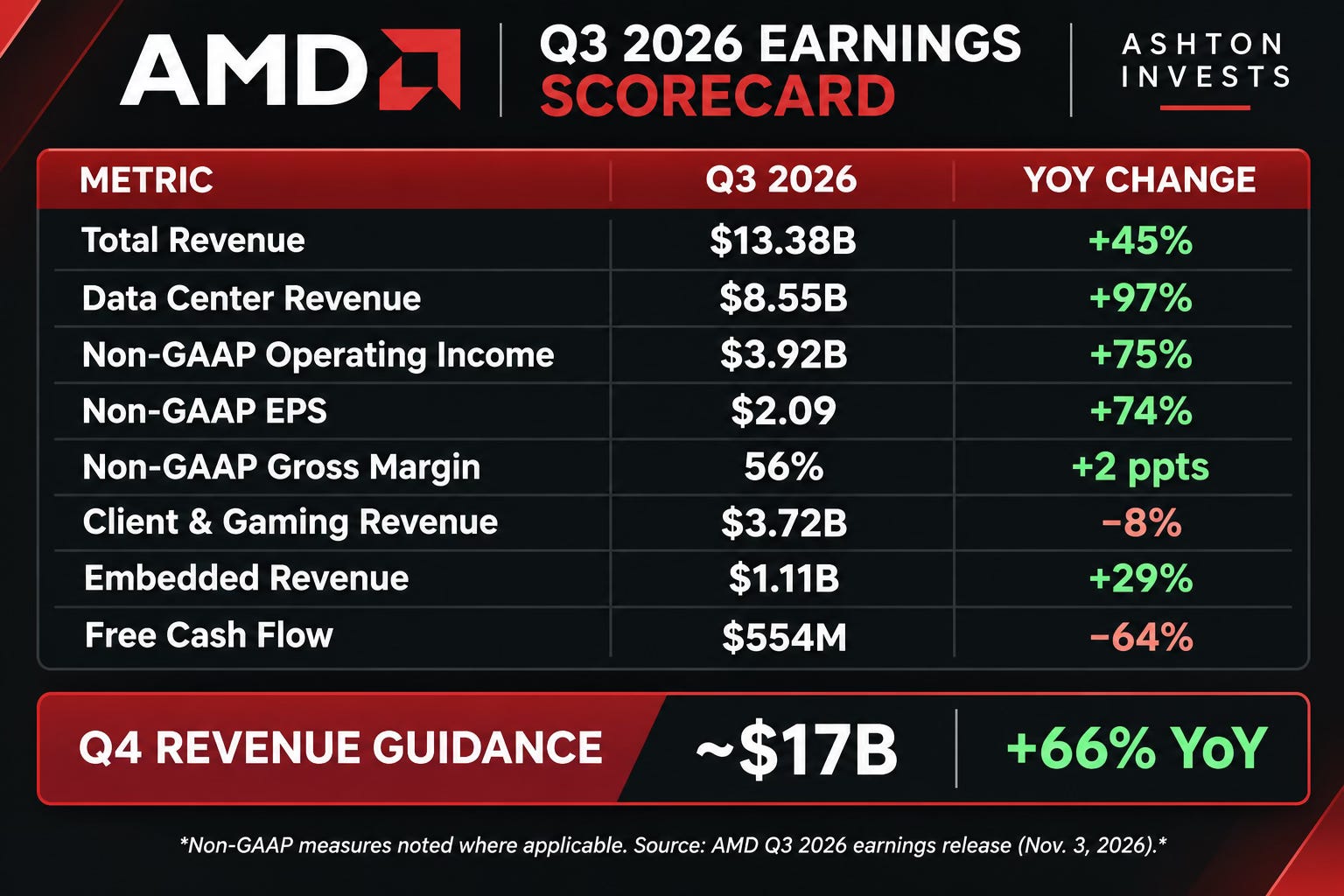
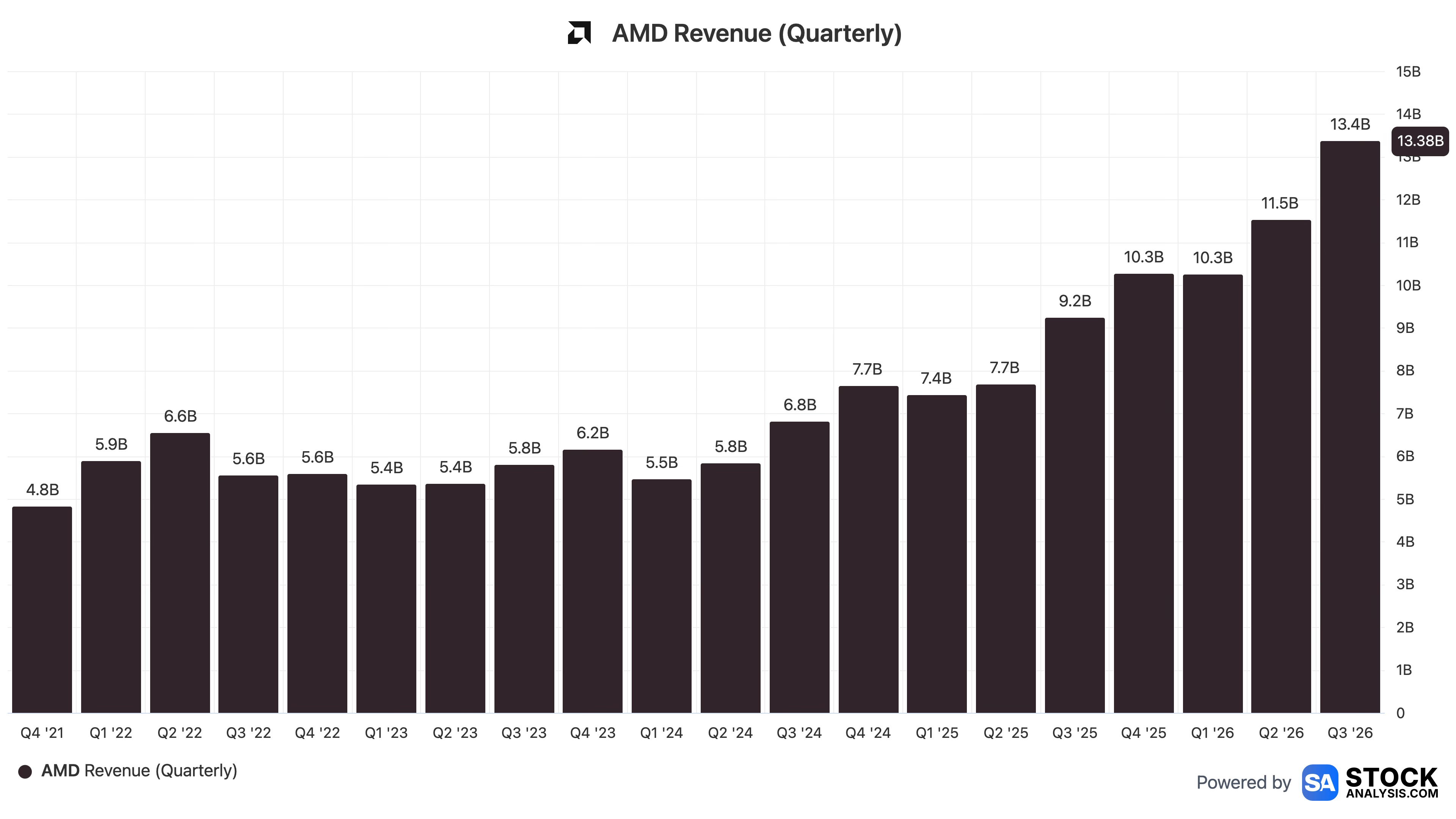
AMD reported record revenue of $13.38 billion, increasing 45% year over year, comfortably exceeding Wall Street’s expectations of approximately $13.09 billion. Adjusted EPS reached $2.09, growing 74% and beating the $1.95 consensus estimate.
Profitability was another major highlight. Adjusted operating income increased 75% to $3.92 billion, while adjusted operating margin expanded from 24% to 29%. Adjusted gross margin also improved approximately 200 basis points to 56%.
What I particularly liked was the operating leverage. Revenue grew 45%, but adjusted operating income increased 75% and adjusted net income grew 77%. AMD is becoming significantly more profitable as its Data Center business scales.
And with management expecting another massive acceleration in Q4, these results might only be the beginning.
Data Center Growth Is Absolutely Incredible
This was easily my favorite part of the quarter.
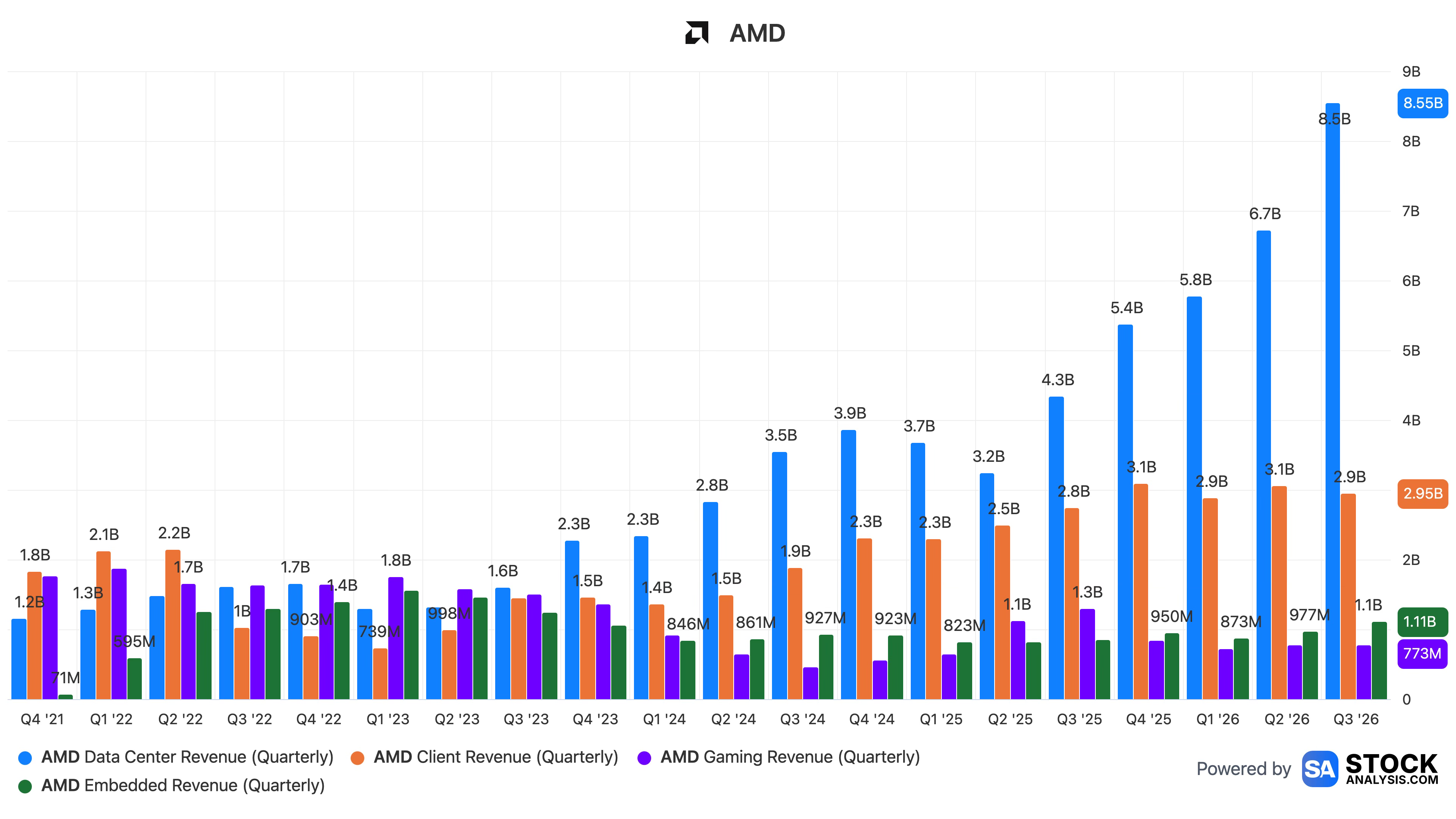
Data Center revenue reached a record $8.55 billion, increasing 97% year over year and 27% sequentially. The segment now accounts for approximately 64% of AMD’s total revenue, compared with just 47% a year ago.
That’s an enormous shift in the company’s business mix in a relatively short period.
What makes the growth even more impressive is the profitability. Data Center operating income increased 168% year over year to approximately $2.9 billion, while operating margin expanded from 25% to 34%.
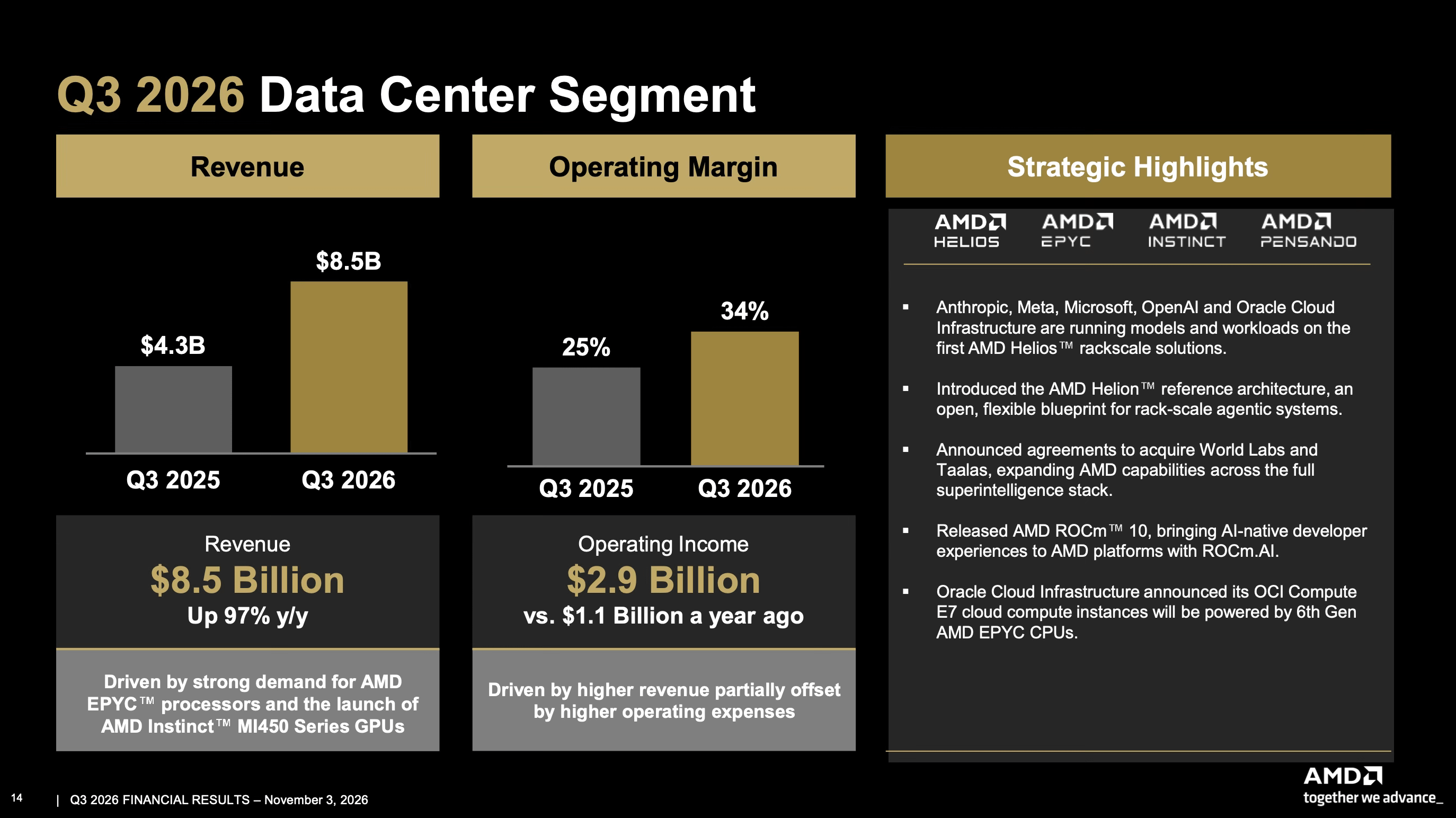
Source: AMD Q3 2026 Financial Results. Slide 14 shows Data Center revenue increasing from $4.3B to $8.5B, operating margin expanding from 25% to 34%, and key strategic developments.
To me, these are some of the most important numbers in the entire report. AMD isn’t simply generating more revenue from AI infrastructure. The segment is also becoming substantially more profitable as demand increases.
Management highlighted particularly strong demand for both EPYC server CPUs and Instinct GPUs. Cloud and enterprise server sales each more than doubled year over year, demonstrating that AMD is benefiting from more than just the AI accelerator opportunity.
I believe AMD has multiple ways to win as demand for computing power continues expanding, and this quarter demonstrated just how powerful that combination can become.
Helios, Instinct, and EPYC: The Opportunity Is Getting Bigger
Another development I was particularly encouraged by was the progress AMD is making with its next-generation products.
The company began volume shipments of MI455X GPUs during Q3, with initial Helios rack-scale deployments already running workloads for customers including Microsoft, Meta, OpenAI, Anthropic, and Oracle.
I think this represents an important milestone. AMD is moving beyond product announcements and customer commitments into actual deployments generating revenue.
Management expects Helios deployments to increase substantially during Q4 as production ramps and additional hardware partners begin shipping systems.
The EPYC business is also performing exceptionally well. AMD began revenue shipments of its sixth-generation Venice processors during Q3, with more than 240 server platforms committed by hardware partners, approximately 20% more than the previous Turin generation.
Another detail that caught my attention was the opportunity surrounding AI agents. Lisa Su explained that increasingly complex AI workloads require substantial CPU capacity alongside GPUs, creating another powerful demand driver for EPYC.
This is something I think investors shouldn’t overlook. As AI infrastructure becomes more complex, AMD has the opportunity to supply multiple critical components rather than relying on one product category.
With MI450, Helios, Venice, and future products like MI500, I believe AMD is positioning itself to capture a significantly larger share of AI infrastructure spending over the coming years.
Profitability, Free Cash Flow, and the Weaker Areas
While the quarter was excellent overall, there were a few numbers worth watching.
Free cash flow declined 64% year over year to $554 million, significantly below expectations. At first glance, that’s a disappointing result, especially considering how quickly profitability is growing.
However, there’s important context behind that decline.
AMD increased inventory by approximately $3 billion during the quarter, bringing the total to $11.5 billion as it prepares to fulfill growing Data Center demand. Accounts receivable also increased by roughly $1.9 billion, while the company continued investing in equipment and production capacity.
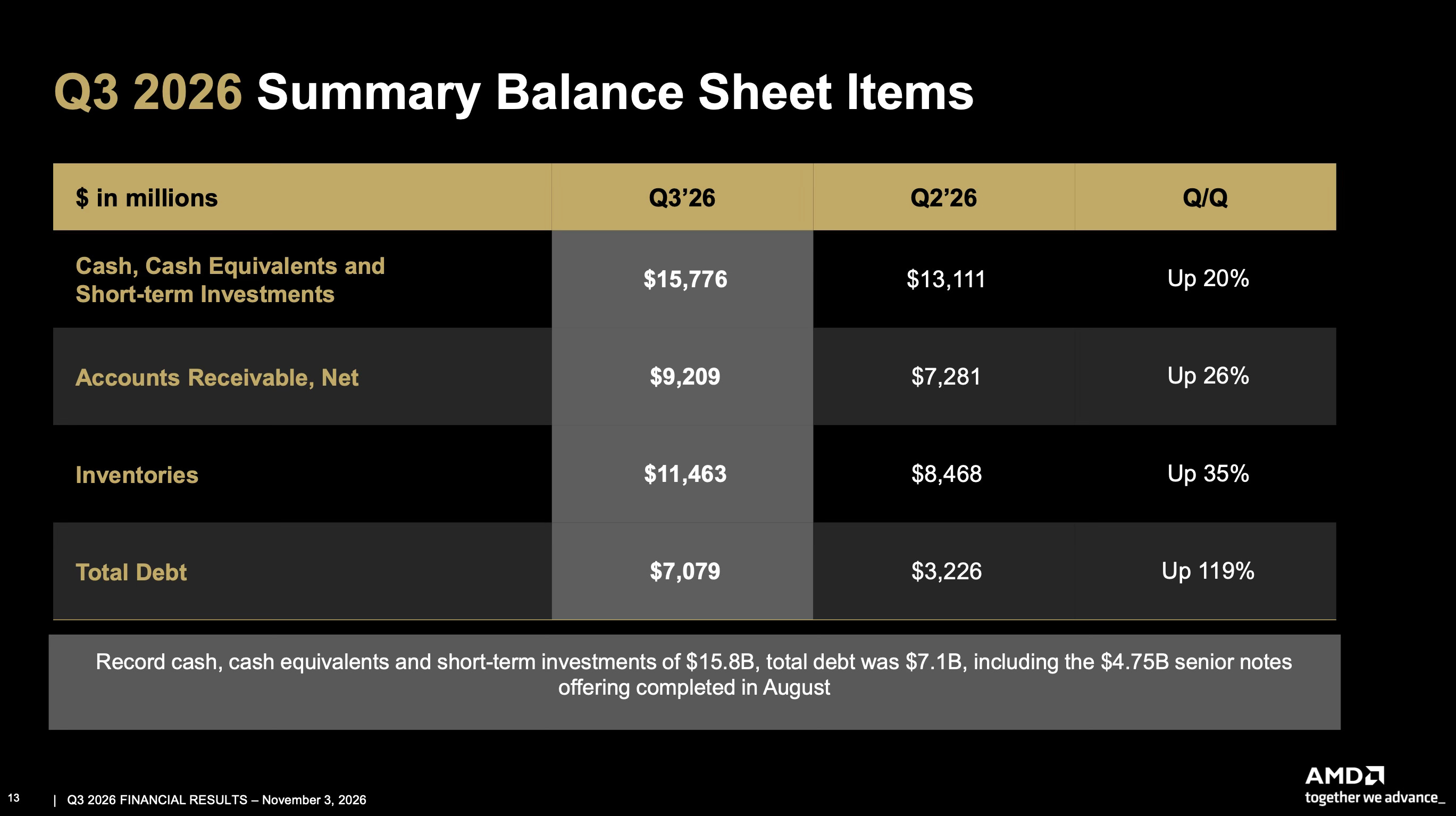
Source: AMD Q3 2026 Financial Results. Slide 13 highlights the increases in inventory and accounts receivable, along with AMD’s $15.8B cash and short-term investment balance.
These working-capital investments are temporarily tying up substantial amounts of cash. Importantly, year-to-date free cash flow still increased approximately 36% to $4.68 billion.
I don’t believe the weak quarterly cash flow changes the long-term thesis, particularly given the scale of the production ramp. However, I want to see those investments translate into stronger cash generation as products ship and customers pay.
Outside Data Center, results were more mixed. Client revenue increased 7% to $2.95 billion, while Gaming revenue declined 40% to $773 million. Embedded revenue was a bright spot, increasing 29% to approximately $1.11 billion.
Management also expects a challenging PC market in 2027, with industry unit shipments potentially declining by double digits.
Those concerns deserve attention, but I believe the strength of AMD’s Data Center business is becoming increasingly important to its overall financial performance.
Q4 Guidance and the Massive 2027 Outlook
This might be the most exciting part of the entire earnings report.
For Q4, AMD expects approximately $17 billion in revenue, representing 66% year-over-year growth and 27% sequential growth.
That’s substantially ahead of the approximately $16.23 billion Wall Street was expecting.
Even more impressively, management expects Data Center revenue to increase approximately 50% sequentially in Q4, driven by the continued ramp of Instinct GPUs and EPYC processors.
CFO Jean Hu also confirmed that AMD expects Data Center AI revenue to surpass its server CPU business in Q4, marking another significant milestone in the company’s transformation.
Adjusted gross margin is expected to be approximately 55%, slightly below Q3 as the product mix shifts toward AI systems.
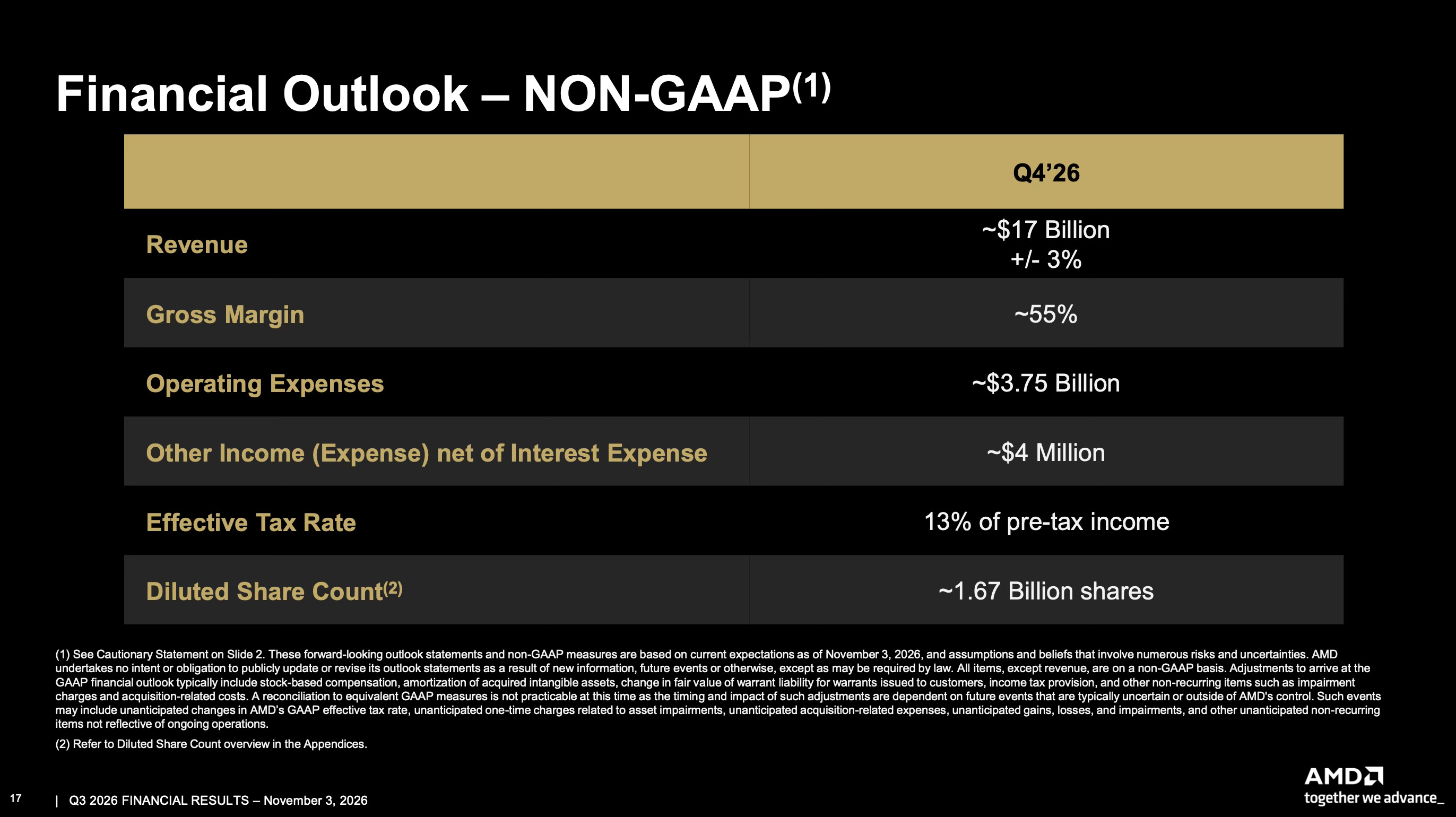
Source: AMD Q3 2026 Financial Results. Slide 17 shows the $17B revenue outlook, approximately 55% adjusted gross margin, and other Q4 financial assumptions.
But the really exciting development came from management’s outlook for next year.
Lisa Su now expects AMD’s total revenue to grow more than 80% in 2027.
That’s an extraordinary expectation for a company already generating tens of billions in annual revenue.
Management also expects server CPU revenue to approximately double in 2027, with Data Center AI revenue growing even faster. Data Center is projected to represent more than 80% of total company revenue, compared with approximately 64% today.
AMD also expects operating expenses to grow at less than half the rate of revenue, which could drive substantial additional operating margin expansion.
I understand these are ambitious expectations, and achieving them will require significant execution. However, management indicated that customer deployment plans have expanded and additional supply has been secured to support the growth.
What excites me is that AMD is entering 2027 with multiple products ramping simultaneously, strong customer demand, and expectations for profitability to grow alongside revenue.
I think this could become an incredibly important year for the company.
What I’m Watching Going Forward
There are a few areas I’ll be paying particularly close attention to following this report.
First, I want to see the Helios and MI450 production ramps continue progressing as management expects. Demand appears incredibly strong, but AMD still needs to execute across manufacturing, supply chains, and customer deployments.
Second, I’ll be watching profitability and cash flow. Gross margins could fluctuate as the product mix changes, and the company continues investing aggressively in inventory and capacity. I want to see those investments turn into substantially stronger free cash flow over time.
Finally, I’ll be watching the competitive landscape. Nvidia remains an enormous competitor, and large cloud providers are developing their own custom silicon. AMD will need to keep demonstrating compelling performance, economics, and software capabilities to sustain its momentum.
Despite those challenges, I believe the company is in an excellent position heading into 2027.
Final Thoughts
Overall, I thought this was a fantastic quarter from AMD.
Revenue increased 45%, Data Center sales nearly doubled, adjusted operating income grew 75%, and management delivered exceptionally strong guidance for the coming quarters.
But what excites me most is the bigger picture.
AMD is becoming a much more important supplier of AI infrastructure, with demand extending across GPUs, server CPUs, networking, and complete rack-scale systems.
The fact that management now expects more than 80% revenue growth in 2027 says a lot about the scale of the opportunity they believe is ahead.
I’m not ignoring the weaker cash flow, potential margin pressure, or the challenges that come with such an aggressive production ramp. Those are important areas to monitor.
However, as a long-term shareholder, I invest in AMD because I believe the company can continue gaining market share while capitalizing on the enormous demand for computing power.
This quarter only strengthened that conviction.
I’m extremely bullish on AMD’s long-term potential, and I’m excited to see what Lisa Su and the team deliver throughout 2027.
Long $AMD.
Enjoyed This Earnings Recap?
If you enjoyed this analysis, consider subscribing to Ashton Invests. I share my research, earnings breakdowns, and thoughts on the companies I own, along with more detailed portfolio updates for paid subscribers.
My Stock Research Platform
StockAnalysis is one of my primary tools for researching companies, tracking financial performance, and reviewing earnings-call transcripts.
Use code Ashton at checkout for a discount on StockAnalysis Pro.

Disclosure: I’m a StockAnalysis partner and may earn a commission if you subscribe through my link or use my code, at no additional cost to you.
Sources
Disclaimer
I am a long-term shareholder of Advanced Micro Devices ($AMD). Everything shared in this article reflects my personal research, opinions, and investment thesis and should not be considered financial advice. All financial information comes from publicly available materials, and management’s projections are not guaranteed. Investing involves risk, so always conduct your own research before making investment decisions.
I may earn commissions through affiliate partnerships, but these do not influence my investment opinions.